Workforce

Introduction
Most business owners focus on revenue. But the real profit leak is hiding inside your own workforce. From rising labor costs to undertrained teams, these five challenges are quietly draining your bottom line — and most operators don't even see it happening until it's too late.
Rising labor costs with no productivity gains to match
The profit compression no one budgeted for
Labor is no longer just your biggest operating expense — it is your most volatile one. According to the U.S. Bureau of Labor Statistics, unit labor costs increased in 25 of 31 service industries in 2024, while compensation for private industry workers rose 3.4% in the 12 months ending March 2026 (BLS, 2026). For restaurants and hospitality operators, the pressure is especially acute: the National Restaurant Association found that labor costs represented a median of 36.5% of sales in 2024, and operators who let that ratio climb above that threshold were far more likely to finish the year unprofitable.
Meanwhile, 92% of restaurant operators reported rising labor costs in the past 12 months and 89% expect costs to keep climbing (Restaurant Business, 2024). In warehousing and distribution, labor productivity actually declined 7.4% annually from 2019 to 2024 — even as hours worked grew 8% — creating a dangerous gap between what businesses pay and what they get in return (BLS, 2025).
Symptoms in your business
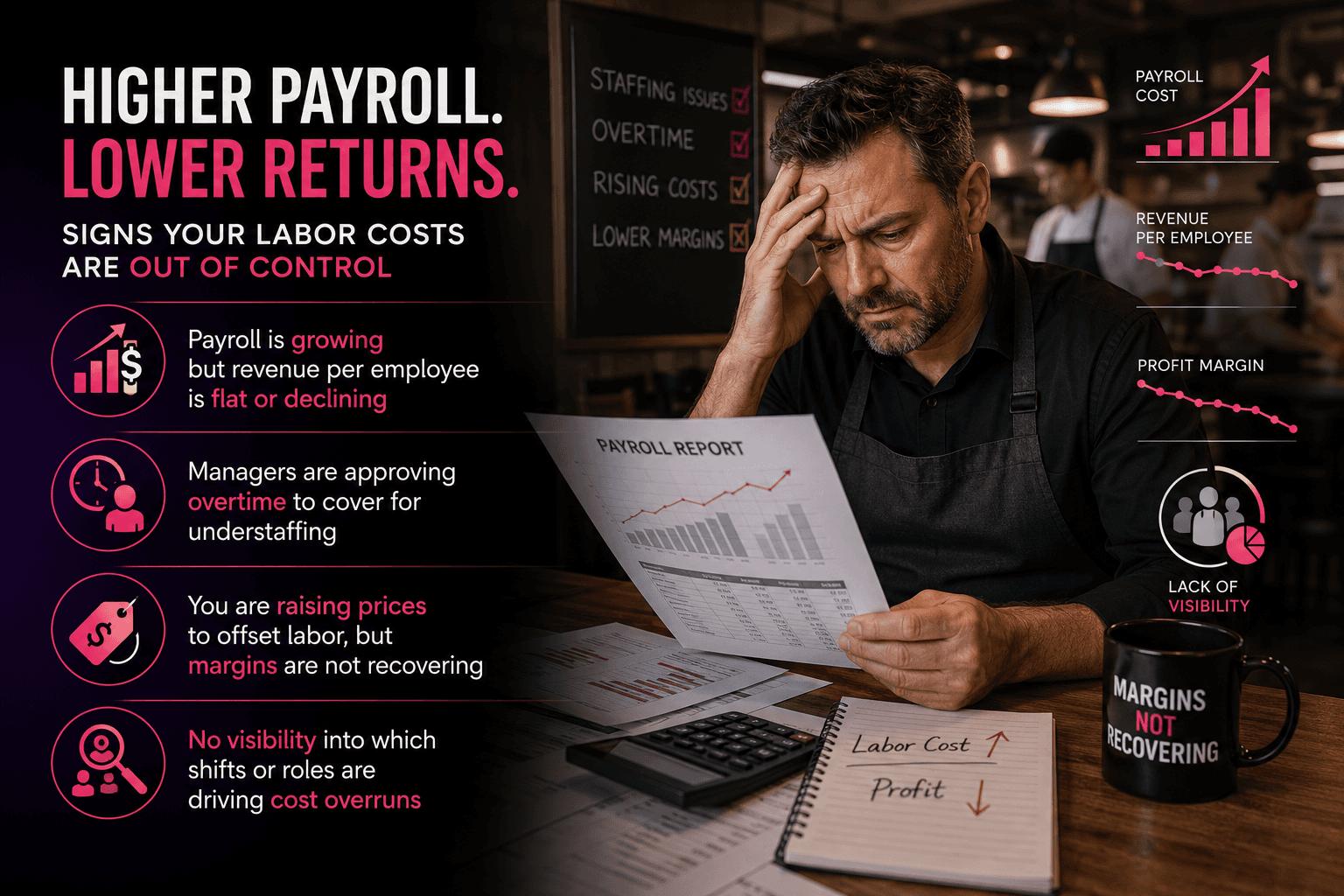
Payroll is growing but revenue per employee is flat or declining
Managers are approving overtime to cover for understaffing
You are raising prices to offset labor, but margins are not recovering
No visibility into which shifts or roles are driving cost overruns
Sources: BLS Productivity and Costs Report, June 2025; National Restaurant Association Operations Data Abstract, 2025; Restaurant Business Market Leader Report, November 2024.
High employee turnover draining your team and your budget
Every exit costs more than you think
Turnover is expensive — and the price keeps going up. The average cost to replace a single employee jumped from $36,723 in 2025 to $45,236 in 2026, driven by higher recruiting, onboarding, and lost-productivity expenses (Insignia Resource, 2026). Across all U.S. companies, the Work Institute estimates that employers spent nearly $900 billion replacing employees who quit in 2023 alone.
In the industries Optimize 360 Group serves, the numbers are even harder. Hospitality posted a 5.3% monthly separation rate in December 2024, food service 5.2%, and transportation & logistics 5.1% — all significantly above the 3.3% cross-industry average (PwC, 2025). The accommodation and food services sector leads all industries with a staggering 56.4% annual turnover rate (Insignia Resource, 2026).
The most important insight from the research: approximately 75% of employee turnover is preventable (Work Institute, 2024). Most employees who leave believed their employer could have done something to keep them. That is not a talent market problem. That is an operations and leadership problem.
Symptoms in your business
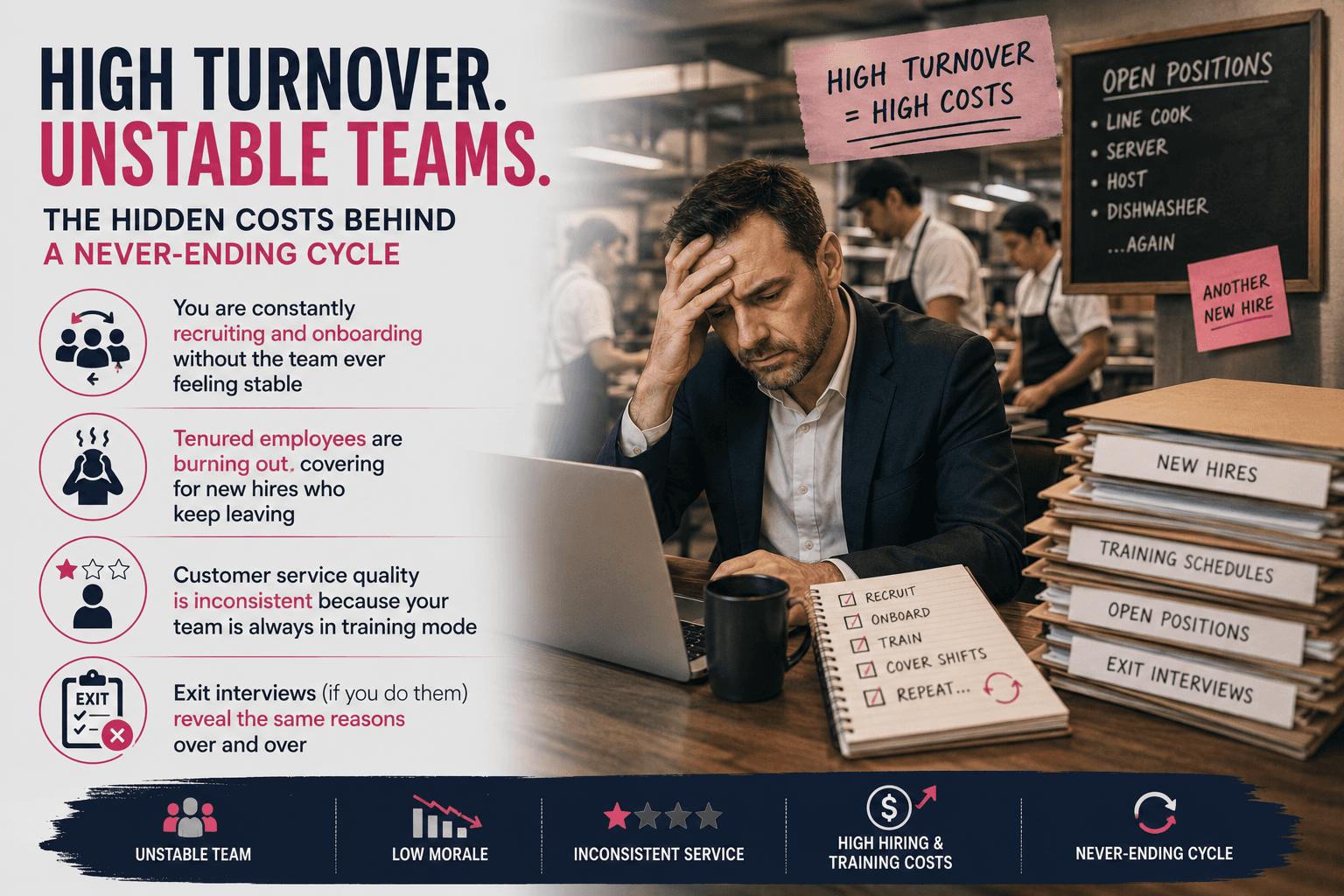
You are constantly recruiting and onboarding without the team ever feeling stable
Tenured employees are burning out covering for new hires who keep leaving
Customer service quality is inconsistent because your team is always in training mode
Exit interviews (if you do them) reveal the same reasons over and over
Sources: Insignia Resource, Average Turnover Rate by Industry, 2026; Work Institute Retention Report, 2024; PwC Next in Consumer Markets Workforce, 2025.
Inconsistent training creating inconsistent results
What your team does not know is costing you customers
Training is not just a HR function — it is a revenue protection strategy. Gallup's research found that only 12% of employees strongly agree their company does a great job onboarding new hires. That means 88% of organizations are sending people onto the floor or into operations without the preparation they need to perform — or to stay.
The consequences compound fast. According to Amazon and Workplace Intelligence (2024), 74% of Millennial and Gen Z employees would leave if not given enough opportunity to develop skills. Companies with a strong learning culture, on the other hand, see 57% higher employee retention (Time Doctor, 2026). Training is not overhead — it is your retention strategy.
In service-based and operations-heavy industries, inconsistent training creates a second problem beyond turnover: it creates inconsistency in the customer experience. When every employee delivers service differently, there is no brand, no standard, and no foundation for growth.
Symptoms in your business
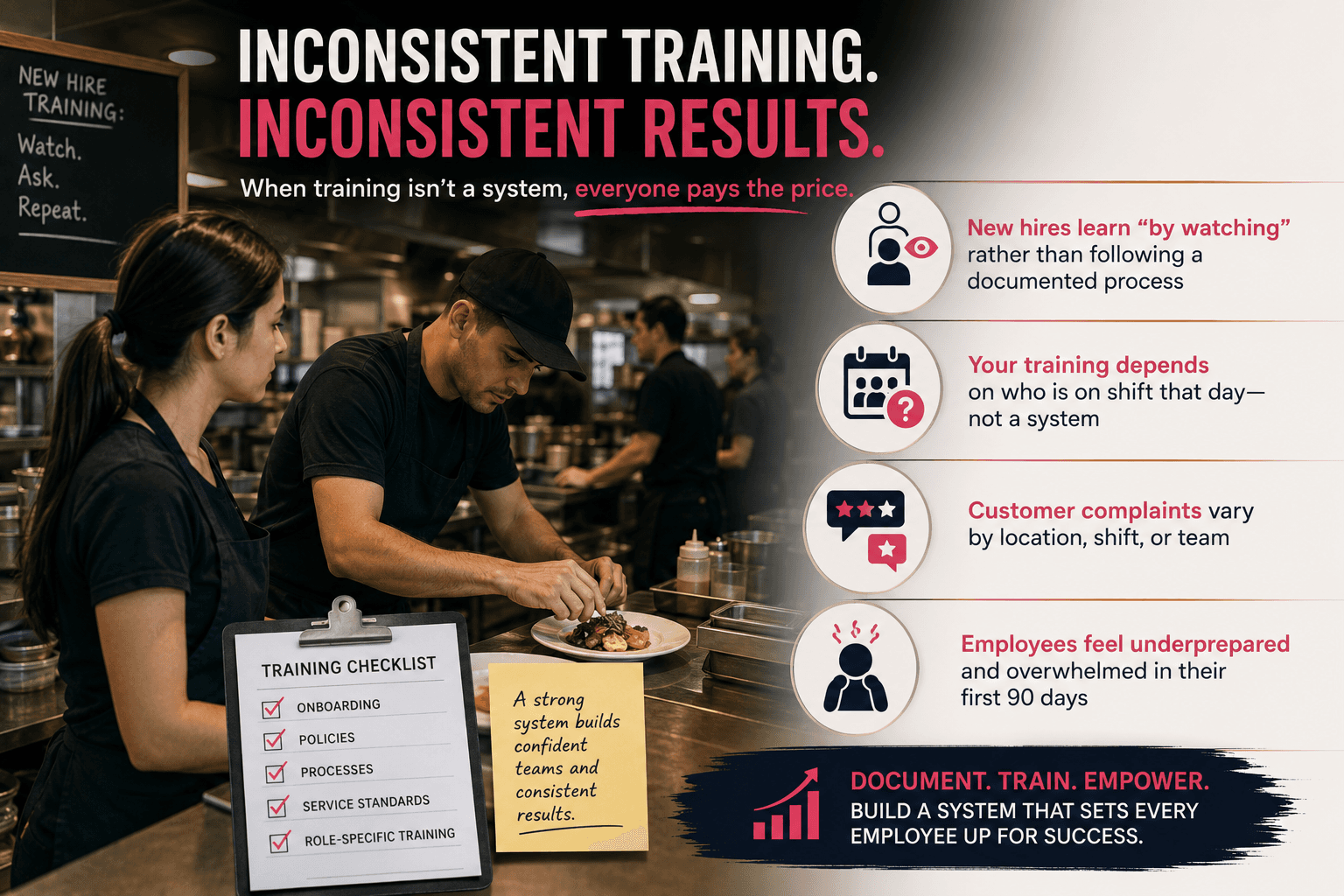
New hires learn "by watching" rather than following a documented process
Your training depends on who is on shift that day — not a system
Customer complaints vary by location, shift, or team
Employees feel underprepared and overwhelmed in their first 90 days
Sources: Gallup Employee Retention & Attraction Indicator, 2024; Amazon x Workplace Intelligence Upskilling Report, 2024; Time Doctor Employee Retention Statistics, 2026.
Lack of accountability eroding performance from the inside
What does not get measured does not get managed
Engagement and accountability are two sides of the same coin — and most workplaces are failing at both. Gallup's 2024 State of the Global Workplace report found that only 23% of the global workforce is actively engaged, while nearly six in ten employees fall into the category of "quiet quitting" — doing the minimum required without commitment. The cost? Low engagement drains $8.8 trillion from the global economy annually, equivalent to 9% of global GDP.
Gallup's research also identifies the root cause of most departures: poor engagement and culture account for 37% of departure reasons, far ahead of pay (11%). Yet most organizations continue to treat compensation as the primary retention lever and overlook the systemic accountability gaps that are actually driving disengagement.
LinkedIn's 2024 Workforce Confidence Survey found that nearly 7 in 10 U.S. workers would quit over a bad manager. People do not leave companies. They leave environments where no one holds standards, recognizes performance, or provides direction.
Symptoms in your business
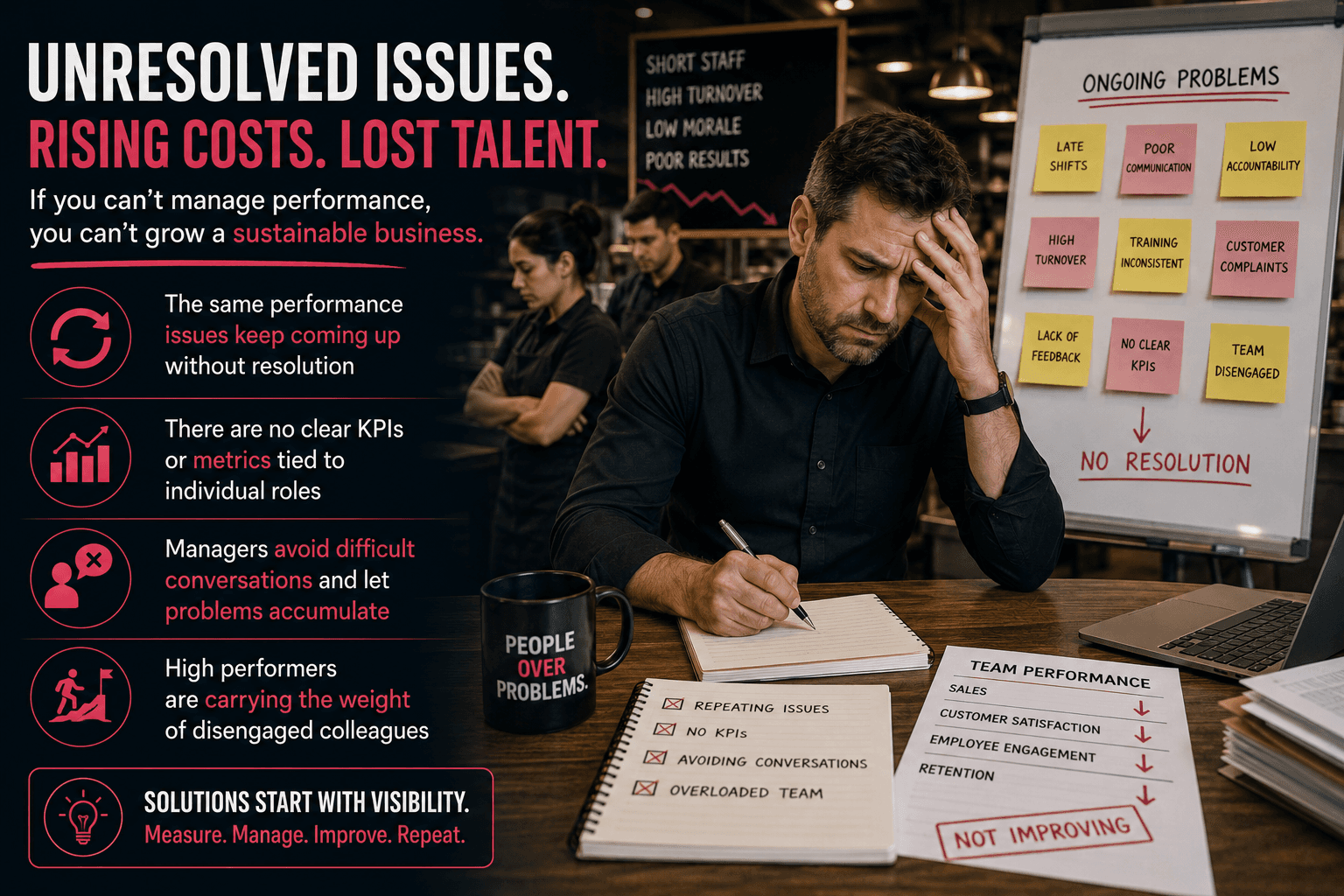
The same performance issues keep coming up without resolution
There are no clear KPIs or metrics tied to individual roles
Managers avoid difficult conversations and let problems accumulate
High performers are carrying the weight of disengaged colleagues
Sources: Gallup State of the Global Workplace Report, 2024; LinkedIn Workforce Confidence Survey, 2024; BambooHR Q4 2024 Employee Satisfaction Survey.
No operational systems to scale without chaos
Growth without structure is just bigger problems
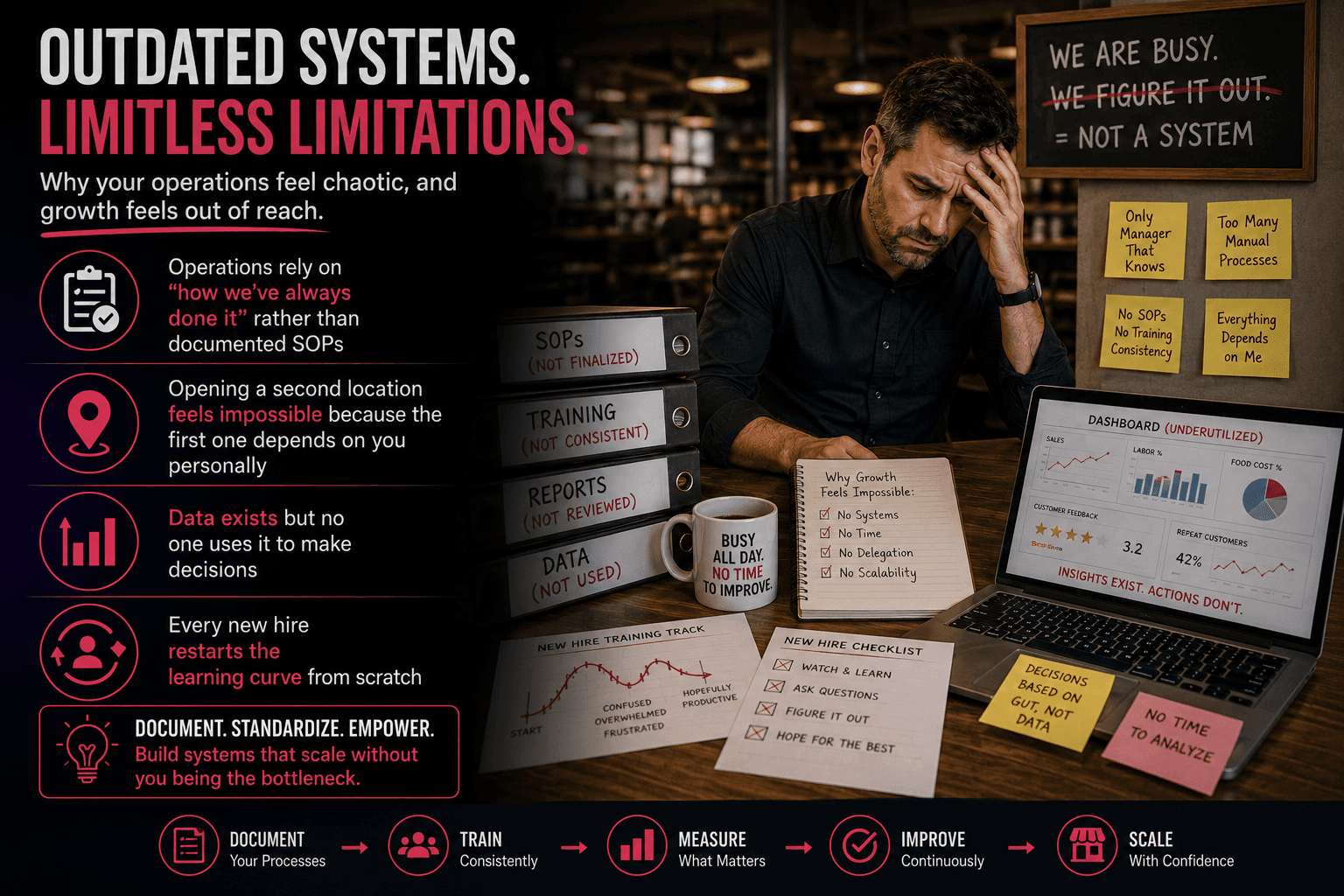
Many businesses grow revenue but not capability. Without documented processes, SOPs, and accountability systems, every new hire, new location, or new service line introduces more variability — and more cost. A 2025 PwC industry study found that over 85% of organizations identify new technology adoption as a primary transformation driver, yet the majority lack the operational foundation to absorb that change effectively.
In frontline industries — restaurants, warehouses, and service organizations — the gap between what leaders think the business looks like and what actually happens on the floor is where margin disappears. 53% of employees say their job now requires specialist training (up from 49% in 2022), and workers who do not receive it are significantly more likely to underperform or leave (Time Doctor, 2026).
The businesses that grow profitably are not the ones that work harder — they are the ones that build systems that replicate results without depending on any single person. Without operational structure, your growth ceiling is determined by whoever your best employee happens to be that day.
Symptoms in your business
Operations rely on "how we've always done it" rather than documented SOPs
Opening a second location feels impossible because the first one depends on you personally
Data exists but no one uses it to make decisions
Every new hire restarts the learning curve from scratch
Sources: PwC Next in Consumer Markets Workforce Report, 2025; Time Doctor Employee Retention Statistics, 2026; BLS Productivity Report, 2025.Data Processing
Conclusion
None of these five challenges exist in isolation. Rising labor costs accelerate when turnover is high. Turnover is high when training is inconsistent. Inconsistent training produces disengaged teams. Disengaged teams operate without accountability. And without operational systems, none of it can be fixed at scale. The businesses that win are the ones that address all five together — systematically, not reactively.
References
Insignia Resource. (2026). Average Turnover Rate by Industry.
Work Institute. (2024). 2024 Retention Report: Employee Turnover Insights and Trends.
Gallup. (2024). State of the Global Workplace Report & Employee Retention and Attraction Indicator.
U.S. Bureau of Labor Statistics. (2025–2026). Productivity and Costs Reports; Employment Cost Index.
National Restaurant Association. (2025). Restaurant Operations Data Abstract.
PwC. (2025). Next in Consumer Markets: Workforce Trends Impacting Labor in 2025.
LinkedIn. (2024). Workforce Confidence Survey.
Mercer. (2025). Workforce Turnover Survey.
Time Doctor. (2026). Employee Retention Statistics.
Amazon & Workplace Intelligence. (2024). Upskilling Report.
Free resource
Get the complete guide
Forty strategies, the diagnostic worksheet and the thirty-day implementation checklist.